A client says: "I want Tier III." Fair enough — but what does that actually change for the building you're about to design?
Four levels of trust
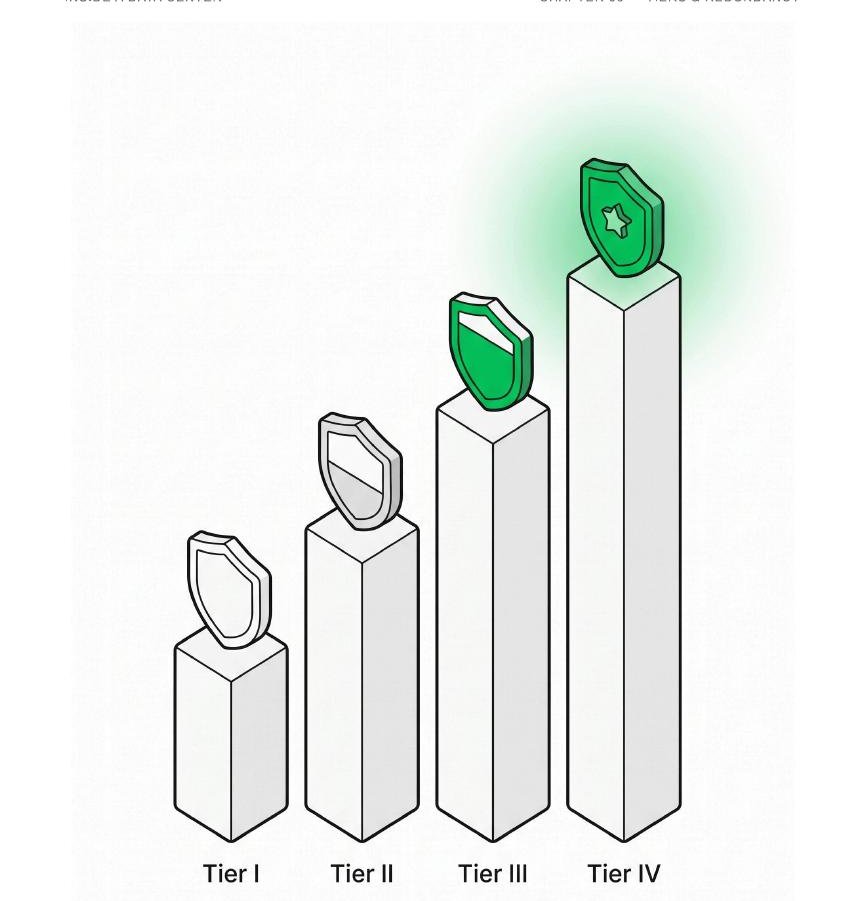
The Uptime Institute defined four Tiers that measure a data center's availability, from simplest to most robust. Each one is really a statement about how much downtime the building is engineered to tolerate:
| Tier | Architecture | ~Downtime/year |
|---|---|---|
| Tier I | Single path, no redundancy | ~28 hours |
| Tier II | Redundant components, still one distribution path | ~22 hours |
| Tier III | Multiple distribution paths, maintenance without interrupting service | ~1.6 hours |
| Tier IV | Full fault tolerance, two paths active simultaneously | ~0.4 hours |
The language of redundancy: N, N+1, 2N
Behind every Tier sits a finer notation that shows up constantly in briefs and spec sheets: N, N+1, and 2N.
N means exactly the capacity needed, with no margin. If one component fails, the system is at risk.
N+1 means the capacity needed, plus one backup unit. A single component can fail without impact.
2N means two complete, independent systems, each able to carry the full load alone. No single failure threatens service — not even during maintenance.
Redundancy is paid for in square meters
Here's the number that tends to surprise people outside the industry: a Tier IV building running 2N can require nearly double the technical floor area of a Tier I building running N — for the exact same IT capacity delivered to the servers. Every generator, every UPS, every chiller exists in duplicate.
That's why two data centers with identical IT power can have radically different footprints. When a client says "Tier III" or "2N" in the very first line of the brief, that's already a floor-area multiplier before you've drawn anything.
Tier measures availability by eliminating single points of failure. The higher it goes, the more the architecture must duplicate its paths — and every extra level of redundancy is paid for in technical square meters, not just money.